
Will AI Take Your IT Job in India? The Honest 2026 Answer: It's the Rung, Not the Job
AI didn't break the building. It removed the bottom step — the routine work every fresher used to learn on. That's a harder problem, and a clearer fix.
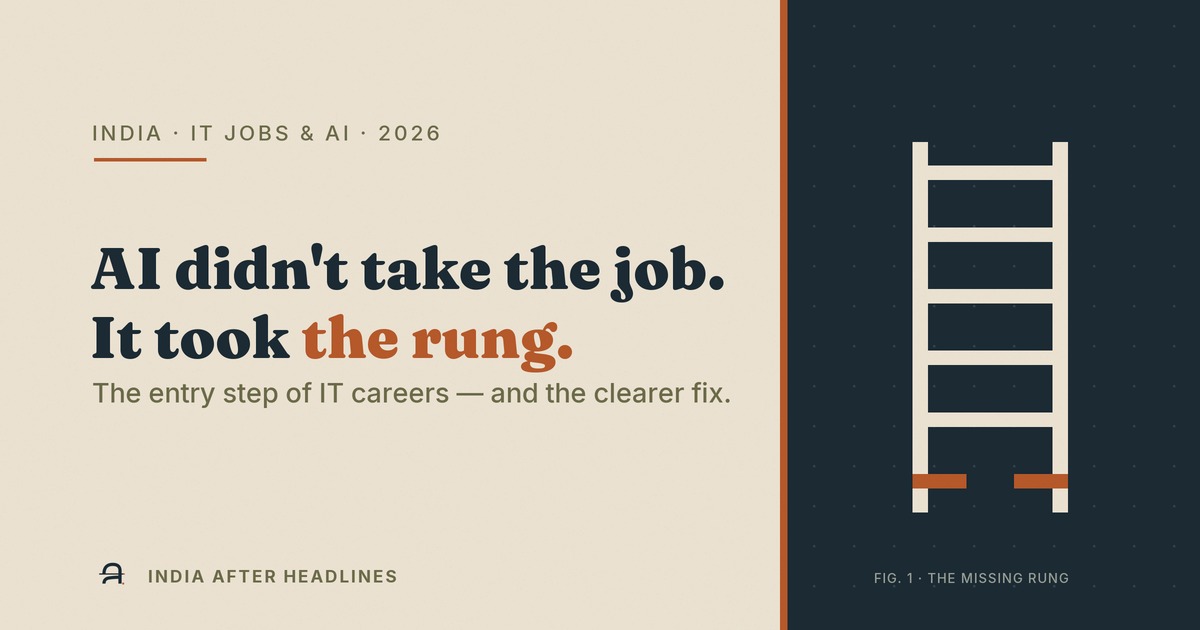
Short answer: No — not the way the headlines imply. AI is not deleting IT careers wholesale. It is automating the bottom rung — routine, entry-level, ticket-closing work — while higher-judgment and AI-skilled roles keep growing. The numbers look terrifying and reassuring at the same time: ~1.34 lakh global tech layoffs in 2026, the first-ever fall in the combined headcount of India’s top five IT firms (about 7,389 fewer in FY26 vs a net add of 12,718 in FY25) — and yet TCS alone made ~25,000 fresher offers in FY27, with Infosys and Cognizant adding ~20,000 each. Both are true. Understanding why is the difference between panic and a plan.
The number that keeps engineers up at night
Meet Rohit — two years in IT, a decent firm, forty tickets a day. Small fixes, simple code, close a client issue, repeat. Life was set. Then, for the first time ever, the meter ran backwards: India’s five biggest IT companies — TCS, Infosys, HCL, Wipro, Tech Mahindra — together went negative on headcount in FY26 after years of only ever growing. The dream sentence — “do engineering, get an IT job, life is set” — wobbled. Rohit’s fear isn’t irrational. The data is real.
But here’s the part that doesn’t fit the fear
The same companies cutting staff are still calling in thousands of fresh graduates. TCS made 25,000 fresher offers from one company. Infosys and Cognizant, ~20,000 more each.
Stop and think. If AI were really eating IT jobs, why line up 25,000 new kids at the door? You don’t do that while shrinking. The contradiction only resolves when you look at what kind of work is being cut and what kind is being hired.
The building, the staircase, and the missing step
Picture an IT office as a pyramid:
- Ground floor: Rohit’s work. Forty tickets, routine code, the simple stuff you learn by doing. This is the first job — the rung every fresher steps onto.
- Floors above: the people who decide, design, check the work, talk to the client.
AI arrived and did not break the building. It broke the lowest step. Those forty routine tickets? AI closes them in minutes. The simple code? AI writes it. So companies need far fewer people on the ground floor — which is exactly why people like Rohit, who only do ground-floor work, are most exposed, and why the fresher door narrowed: TCS’s ~25,000 offers is its lowest since FY20, down from ~44,000.
One statistic says it in a line: at Infosys, employees under 30 are now only 50.7% — the lowest in 15 years. The young, just-arrived slice is shrinking.
The building still stands. It’s the staircase that’s gone. AI didn’t erase the job — it erased the rung you used to climb on.
Both sides, honestly
This is the part that matters for your home, because there’s a real Rohit in many houses — a two-year engineer, or a fresher who’s been job-hunting for two years.
- The company isn’t the villain. AI genuinely makes work faster and cheaper, and the engineer who uses AI to do the work of ten is being paid more. Those people aren’t failing — they’re climbing.
- The fresher got robbed of the on-ramp. The plan was “learn by doing simple work for two years, then rise.” Those two years of simple work no longer exist. So how do you climb a staircase whose first step was removed?
The villain isn’t a company or the government. It’s a shift that arrived and warned no one.
What to do
- If you’re Rohit: stop being the person who closes tickets and become the person who makes AI close forty tickets — then checks whether AI did it right. Move from doing the work to judging it. That supervise-and-verify skill is what’s getting paid more today.
- If you’re a fresher: the door isn’t shut — thousands still walk through it — but it no longer asks for a degree. It asks: can you get work done through AI? Enter AI-fluent and you fit through the smaller door. Carry only a certificate and you wait outside.
- Either way, don’t freeze. Fear makes people do the wrong thing — paralyse, or panic into a bad move. In this building, the safe person is simply the one who’s hard for a machine to replace.
Related, same pillar: Are Indian IT companies still hiring freshers in 2026 while firing thousands? — the cost logic running both at once.
Sources
- Layoffs trackers — ~1.34 lakh global tech-sector job cuts in 2026 (year-to-date)
- Company FY26 disclosures — combined headcount of TCS, Infosys, HCLTech, Wipro, Tech Mahindra fell ~7,389 in FY26 (vs net +12,718 in FY25)
- TCS — ~25,000 fresher offers in FY27 (down from ~44,000 in FY26; lowest since FY20)
- Infosys / Cognizant — ~20,000 fresher additions each; Infosys under-30 share at 50.7% (15-year low)
Will AI take my IT job in 2026?
Not wholesale. AI is automating the bottom rung of IT — routine, entry-level, ticket-closing work — rather than deleting entire careers. Higher-judgment and AI-skilled roles are still growing. The risk is concentrated on people whose work is purely routine; the fix is to move from doing routine tasks to supervising and judging AI's output.
If AI is cutting jobs, why are IT companies still hiring freshers?
Because they're cutting and hiring different kinds of work. In 2026 the combined headcount of India's five biggest IT firms fell for the first time (about 7,389 fewer in FY26 vs a net add of 12,718 in FY25), yet TCS alone made about 25,000 fresher offers in FY27, with Infosys and Cognizant adding roughly 20,000 each. They're shedding routine capacity AI can now handle while still bringing in new, AI-fluent talent — just fewer of them.
Is IT still a good career in India in 2026?
Yes, but the entry path changed. Hiring continues — though TCS's ~25,000 fresher offers in FY27 is its lowest since FY20, down from ~44,000 — and Infosys's under-30 share has fallen to 50.7%, a 15-year low. A degree alone no longer opens the door; AI fluency does. The career is intact; the old 'learn by doing routine work for two years' on-ramp is what's disappearing.
What should an IT engineer do to stay safe from AI?
Shift from doing the work to judging the work. Instead of closing 40 routine tickets yourself, become the person who makes AI close them and then checks whether AI did it right. That supervise-and-verify skill is what companies are paying more for — the engineer who does the work of ten with AI is getting paid more, not less.
How should a fresher break into IT now that entry roles are shrinking?
Enter AI-fluent, not degree-only. Thousands of fresher roles still exist, but the door now asks whether you can get work done through AI tools, not just whether you have a degree. The candidate who can demonstrate real AI-assisted productivity walks through the smaller door; the one carrying only a certificate waits outside.
Are Indian IT Companies Still Hiring Freshers in 2026 — While Firing Thousands?
Both headlines are true at the same time. That isn't a contradiction. It's the plan.